25 Lessons At 25
5/9/20268 min read
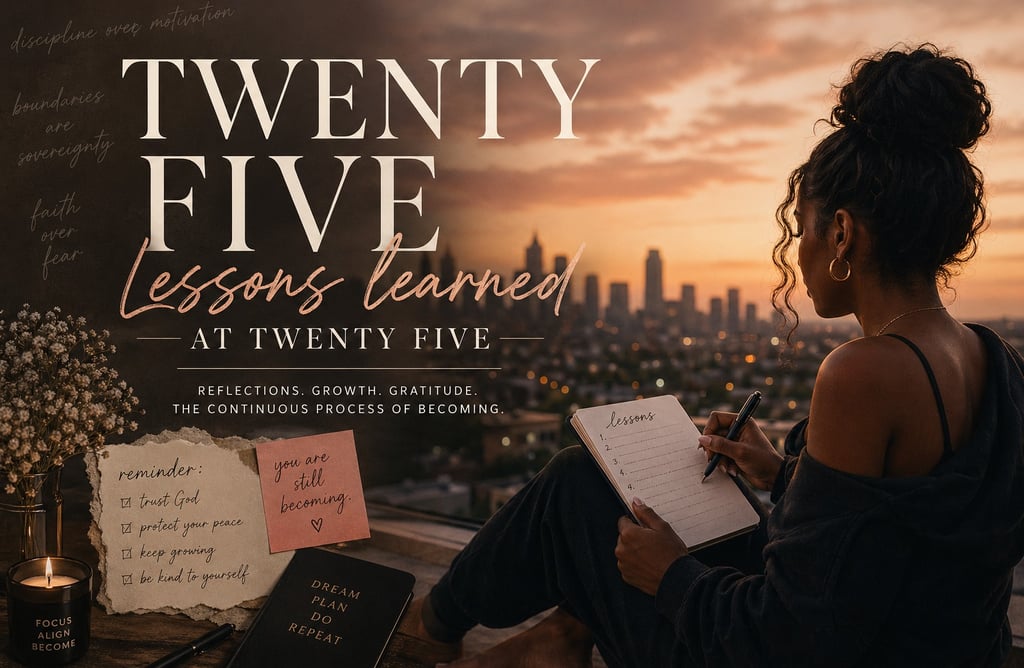
Twenty Five lessons learned at Twenty Five
Time waits for no one. It feels like I was just twenty yesterday—until I remember being in college, working retail shifts, and pushing myself toward becoming a lawyer.
It’s strange how life unfolds. Nothing ever quite goes according to plan. Everything I thought I would become is, in many ways, everything I am not.
Yet here I am—twenty five. Healthy. With a roof over my head, parents who love me, goals already achieved, and even bigger ones still ahead of me.
And still, there are moments when it feels like nothing I do is enough. It’s difficult to be proud of where I am when my mind is always focused on where I want to be.
And if I ever doubt the distance between who I was and who I am becoming, may these twenty-five lessons learned at twenty-five remind me just how much I’ve grown.
The Pain of Being Understood but Not Chosen. Not everyone who understands you will choose you. And sometimes that hurts more than being misunderstood. But learning to loosen your attachment to people creates the space to heal and find your way back to yourself.
Boundaries are sovereignty. It isn’t selfish to stop pouring into people who have grown comfortable receiving without giving.
Ambition is both selectively and lonely.The more you elevate, the fewer people understand the vision you’re pursuing, and that gap can create its own kind of emotional strain.
Trust in God, even when it hurts to release what you thought was meant for you—whether it’s a relationship, a job, or a place you called home. Faith is what keeps you moving when your heart wants to hold on.
Motivation is fleeting, but discipline endures. It’s the quiet decision to keep showing up and finishing what you started, even when obstacles appear. And when the path shifts, you learn to pivot without giving up. Discipline will feel like sacrifice
Trauma doesn’t simply disappear. Sometimes it resurfaces when you’re doing well and tries to convince you that you are less than who you truly are. But you still have power over how you respond. When you feel triggered, step out of your mind and move—pray, cry, work out, read, write. Do anything that helps you keep moving forward instead of sitting with the demons you’re fighting. What you went through does not make you dirty—it makes you powerful.
Audit your social circle. Real friends are the people you would trust to see you at your most vulnerable. If you wouldn’t want them beside you in your hardest moments, they were never meant to be close. Having older friends is so much better they put you on to life.
Treat dating like your bank account—don’t let romance constantly withdraw from you. A healthy relationship should deposit into your life and feel like an investment. The most important dating question to ask is: What are your top five responsibilities? If their priorities don’t align with yours, save yourself the future heartbreak.
When you look good, you feel good—but that doesn’t mean chasing fashion trends or designer labels. It means taking care of yourself: maintaining your skin, hair, and nails, and dressing simply but intentionally.
Healing doesn’t mean the memories stop hurting. It simply means they stop controlling you. You choose not to let the pain consume you. Sometimes healing looks simple—making your bed each morning, eating nourishing food, and protecting your mind from artificial noise, gossip, and content that constantly pressures you to change who you are.
You become what you consume. The music you play, the TikToks you scroll, the conversations you entertain—it all shapes your mindset. If your daily feed is filled with gossip, rap music glorifying toxic lifestyles, people flexing money, women chasing procedures, or drama-based content, it slowly influences how you think about life and yourself.
Money solves many problems—but not the emotional ones. I’ve made a lot of money for someone who is twenty-five, and for a while I believed the luxuries would fill the gaps: being able to call off work without worrying about my paycheck, driving a flashy car, buying the newest phone whenever I wanted. I thought those things might somehow validate or quiet the emotions I carried. But the truth is, money can ease stress and create comfort, yet it can’t permanently fix how you feel inside. At best, it offers temporary relief—not lasting happiness.
Silence reveals more than arguments ever will. When I was younger, I believed clarity came from confrontation—that if I explained myself well enough or asked the right questions, people would reveal their true intentions. But at twenty-five, I’ve learned that silence often tells the truth much faster than words. When someone stops calling, showing up, or choosing you, their absence speaks louder than any explanation. As my life has grown with ambition, responsibility, and bigger goals, my circle has naturally shifted. Some people admire the direction I’m going, while others quietly distance themselves—and instead of arguing to keep them close, I’ve learned to observe what their silence reveals. Not every relationship needs an explanation, and not every distance needs to be repaired. Sometimes silence is simply life reorganizing your environment so the people who truly align with who you’re becoming can find their place.
At some point in life, you will be the bad guy in someone’s story. I know I have made mistakes. Some came from ignorance, others from selfish choices I didn’t fully understand at the time. But I don’t regret them, because those moments—flawed as they were—helped shape the woman I am today. If I spent my time replaying everything I should have done differently, I would never appreciate the growth that came from those experiences or the woman I am still becoming.
It’s my parents’ first time on earth too. I forgive them for the things they did wrong because I don’t know what it’s like to be a parent, so who am I to claim I would have done everything perfectly? I spent years feeling insecure, hurt, and depressed, but holding onto that pain only kept me stuck. At twenty-five, I’ve realized that forgiveness isn’t about excusing everything—it’s about choosing peace. I don’t want to carry mommy and daddy issues into the rest of my life when what I experienced was simply emotional neglect from people who were also learning how to live.
My identity is not defined by the money I make, the interests I hold, the race I was born into, or the mistakes I’ve made along the way. Identity is something that grows and shifts with time. I’m allowed to change, to explore, and to become different versions of myself as life unfolds. As adults, we should have hobbies and passions that nurture that growth and remind us that we are still evolving. Sometimes I am a rapper, a former law student, an entrepreneur, a daughter, a sales agent, or a neuroscience coach. All of those roles exist within me, but none of them fully define me. I am simply myself—and that never needs an explanation.
People admire your strength but rarely ask how heavy it is to carry. Independence has taught me that. I’ve learned how to move through life on my own—driving myself to the hospital at three in the morning with no one to call, traveling alone for both pleasure and business, creating art, making mistakes, spending money, fighting through hard moments, and still showing up. From the outside, people admire that kind of strength. They celebrate the light you carry. But around the wrong people, that same light can make them uncomfortable, and they will slowly try to dim the fire that keeps you going. I’ve learned to trust that God removes the people who do not mean well, even when it hurts to watch them leave. What is not meant for you will disappoint you again and again until you finally release it. Some people will praise your strength but never hold you when you are struggling. Those are the people you must learn to keep at a distance.
Your environment builds your reality. You can’t be surprised if you’re broke while surrounded by people who normalize being broke. You can’t expect to prioritize health if the people around you never work out or take care of themselves. The people around you shape your habits and your expectations. A strong environment creates a healthy ecosystem—one where people support each other, not just when there’s something to gain. Sometimes the most important thing you can do for your life is change your environment until it aligns with who you want to become.
Go on a solitude journey. I spent a year and a half mostly alone. I stopped seeing people and poured myself into work, studying, writing essays for fun, auditing my life, organizing everything around me, building projects, failing at them, running, and watching friendships quietly fade. I even removed my bed and slept on the floor just to remind myself to stay grounded. At times I felt like Rapunzel—isolated in my own tower. But solitude taught me something most noise never could: life can change at any moment. Because of that, peace has to come from within your own mind. Let go of attachments to things and people that you believe you need. Keep evolving. Don’t stay stuck in how life was supposed to unfold—accept it for what it is and keep moving forward.
You don’t always need to be improving, producing, or chasing the next goal. Sometimes life is meant to be slow—cooking a good dinner, watching TV, reading a book, walking outside, turning your phone off, and being present in your own life. That isn’t laziness. That’s balance.
Sometimes you finally reach the things you spent years praying for—money, opportunities, progress—and you still catch yourself feeling unsure. I used to think success would magically erase doubt, like once you “make it” everything in your mind just settles. But it doesn’t work like that. Real growth is learning how to be grateful for how far you’ve come while still admitting you’re figuring it out as you go. Success isn’t the end of uncertainty—it’s just a new level of responsibility and self-trust.
The bigger your vision gets, the more people start projecting their fears onto you. It’s not always because they dislike you—sometimes your courage just reminds them of the chances they were too scared to take. I’ve learned that when people say something can’t be done, they’re usually speaking from their own limits, not yours. You can listen, but you don’t have to carry their fear with you. Sometimes the boldest thing you can do is keep going anyway.
I’ve learned you don’t actually owe everyone an explanation for the way you live your life. Some people will question your decisions, your boundaries, or the direction you’re going in—but that doesn’t mean they’re entitled to an answer. Sometimes the real response is turning the question back around and asking why they feel so comfortable questioning you in the first place. The older I get, the more I realize peace comes from standing firm in your choices without feeling the need to justify them. Not everyone deserves access to your reasoning.
I used to think life moved slowly, like I had all the time in the world to figure things out. But somewhere along the way the years started passing quietly. One day you’re twenty, just dreaming about who you might become. The next you’re twenty-five and realizing the life you imagined isn’t coming someday—it’s already happening. Time doesn’t always rush loudly; sometimes it just slips by while you’re busy becoming someone.
You are still becoming.At twenty-five, I’m beginning to understand that life isn’t about arriving at some perfect, finished version of yourself. It’s a constant process of reflection, adjustment, and growth. In many ways, life itself is a continuous audit—examining your habits, your relationships, your beliefs, and asking whether they still align with the person you are becoming. Some days I feel strong and certain; other days I feel lost and unsure. But both are necessary, because becoming the right version of yourself requires the humility to keep auditing your life and the courage to evolve when something no longer fits.
At twenty-five, I am beginning to understand that life is less about arriving somewhere perfect and more about continuously auditing who you are becoming. The lessons don’t stop once you reach a milestone, and certainty rarely arrives when you expect it to. Growth is quieter than I imagined—it happens in reflection, in solitude, and in the small decisions to keep moving forward even when the path feels unclear. If these twenty-five lessons prove anything, it is that the woman I am today is not the final version of me. She is simply another step in the long process of becoming.